
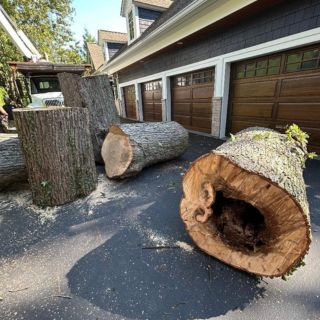
Trees add beauty, shade, and value to your property, but they don’t last forever. Storms, disease, pests, and old age can weaken even the healthiest-looking trees. While many tree problems can be solved with pruning, some situations make removal the safest and most practical option.
The challenge is knowing the difference between a tree that needs maintenance and one that has become a hazard.
Research from the U.S. Forest Service shows tree failures often link to structural defects. These include decay, cracks, root damage, weak branch unions, and dead limbs. These visible defects are important indicators that a tree may no longer be structurally sound.
If you’ve been wondering whether it’s time to remove a tree on your property, this guide explains the warning signs you should never ignore.
Why Tree Health Matters
A healthy tree provides years of environmental and financial benefits. It improves curb appeal, offers shade, reduces energy costs, and supports local wildlife.
However, a declining tree can quickly become a liability. Dead branches, hidden decay, or weak roots raise the risk of falling limbs or total tree failure. This risk is higher during Michigan’s heavy snow, ice storms, and high winds.
Identifying problems early allows homeowners to decide whether tree trimming and removal services can restore the tree or whether complete removal is the safest solution.
1. The Tree Is Dead
A dead tree is one of the clearest signs that removal is necessary.
Unlike dormant trees, dead trees no longer produce new growth and become weaker over time.
Common signs include:
- No leaves during the growing season
- Dry, brittle branches
- Bark falling off in large sections
- Dead twigs throughout the canopy
- Mushrooms growing near the trunk or roots
Dead trees become increasingly unstable and should not be left standing near homes, driveways, sidewalks, or power lines.
In these situations, dangerous tree removal is often the safest option.
2. Large Dead Branches Throughout the Canopy
Dead limbs don’t always mean the entire tree needs removal.
However, when large portions of the canopy have died, the tree may be suffering from serious internal decline.
Large dead branches can:
- Break unexpectedly
- Damage roofs and vehicles
- Injure people below
- Spread decay deeper into the tree
Sometimes tree trimming services can remove isolated dead limbs. But if most of the canopy has declined, removal may be more appropriate.
3. The Tree Is Leaning Suddenly
Some trees naturally grow at an angle.
A sudden lean, however, is very different.
Trees that begin leaning after storms or heavy rain may have experienced root failure.
Watch for:
- Soil lifting around the base
- Exposed roots
- Cracks in the surrounding ground
- Movement during windy weather
The U.S. Forest Service identifies root problems as one of the primary structural defects associated with hazardous trees because compromised roots significantly increase the likelihood of failure.
4. Deep Cracks or Splits in the Trunk
The trunk is the tree’s main structural support.
Large vertical cracks or split trunks often indicate severe structural weakness.
These defects may result from:
- Lightning strikes
- Storm damage
- Internal decay
- Rapid temperature changes
- Heavy branch weight
Once major trunk damage develops, the tree’s ability to support its own weight decreases significantly.
Professional evaluation is recommended immediately.
5. Visible Decay or Hollow Areas
Not all decay can be seen from the outside.
In fact, research shows internal decay often extends much farther than external symptoms suggest.
According to research published by the U.S. Forest Service, arborists frequently combine visual inspections with specialized testing methods because hidden decay may not be fully visible from the tree’s exterior.
Signs that decay may be present include:
- Mushrooms or fungal growth
- Hollow sections
- Cavities
- Soft wood
- Carpenter ants inside the trunk
- Unusual swelling around wounds
While small cavities don’t always require removal, extensive decay often weakens the tree’s structural integrity.
6. The Roots Are Damaged
Healthy roots anchor the tree and absorb water and nutrients.
When roots are severely damaged, the entire tree becomes unstable.
Common causes include:
- Construction work
- Soil compaction
- Excavation
- Flooding
- Root rot
Unfortunately, root problems often go unnoticed until the tree begins leaning or declining.
Because roots cannot easily be repaired, severe damage may require removal.
7. More Than Half the Tree Is Damaged
If over 50% of the canopy has died or major portions of the trunk have been compromised, recovery becomes much less likely.
Extensive decline often results from:
- Disease
- Severe insect infestations
- Drought stress
- Storm damage
Professional arborists evaluate how much healthy structure remains before recommending treatment or removal.
8. The Tree Is Too Close to Structures
Even healthy trees can become problematic when planted too close to homes.
Potential issues include:
- Roof damage
- Foundation concerns
- Branches rubbing against the house
- Gutter blockage
- Limited growing space
Sometimes pruning solves the problem.
Other times, complete removal provides the safest long-term solution.
9. Repeated Storm Damage
Michigan weather can place enormous stress on mature trees.
If the same tree repeatedly loses large branches during storms, it may have hidden structural weaknesses.
Research examining urban tree failures has found that defects, branch architecture, species characteristics, and previous damage all influence how trees respond during severe weather.
Trees with repeated storm damage often become candidates for dangerous tree removal before a complete failure occurs.
10. The Tree Is Threatening People or Property
A tree doesn’t have to be completely dead to become hazardous.
If it could strike:
- Your home
- Garage
- Vehicles
- Sidewalks
- Utility lines
- Children’s play areas
it deserves immediate attention.
If there’s an immediate risk of failure after a storm or another unexpected event, emergency tree removal may be necessary to prevent injuries and property damage.
Can the Tree Be Saved Instead?
Not every unhealthy tree needs to come down.
Many problems can be corrected through proper maintenance.
Professional tree trimming and removal services often recommend pruning when:
- Only a few branches are dead
- Storm damage is limited
- The tree is otherwise healthy
- Structural issues are minor
Proper pruning reduces weight, improves airflow, removes hazardous limbs, and extends the tree’s lifespan.
The decision between trimming and removal depends on the tree’s overall condition, not just one visible problem.
Why Professional Assessment Matters
Many structural defects aren’t visible from the ground.
Research has shown that experienced arborists combine visual inspection with specialized assessment techniques to evaluate internal decay and determine the likelihood of failure. Even among trained professionals, assessing tree risk involves careful evaluation because hidden defects are not always obvious.
Attempting to diagnose or remove a hazardous tree yourself can be dangerous. This is especially true with large trees, storm damage, or trees near structures or power lines.
Final Thoughts
Healthy trees are one of the greatest assets a property can have, but safety should always come first. Warning signs such as dead branches, deep trunk cracks, visible decay, root damage, sudden leaning, and repeated storm damage should never be ignored. While many trees can be saved with tree trimming services or professional pruning, others need dangerous tree removal.
Emergency tree removal may also be needed to protect people and property.
If you’re unsure about the condition of a tree, a professional inspection is the best first step. Early evaluation can help determine whether maintenance is enough or whether removal is the safest long-term solution for your landscape.