
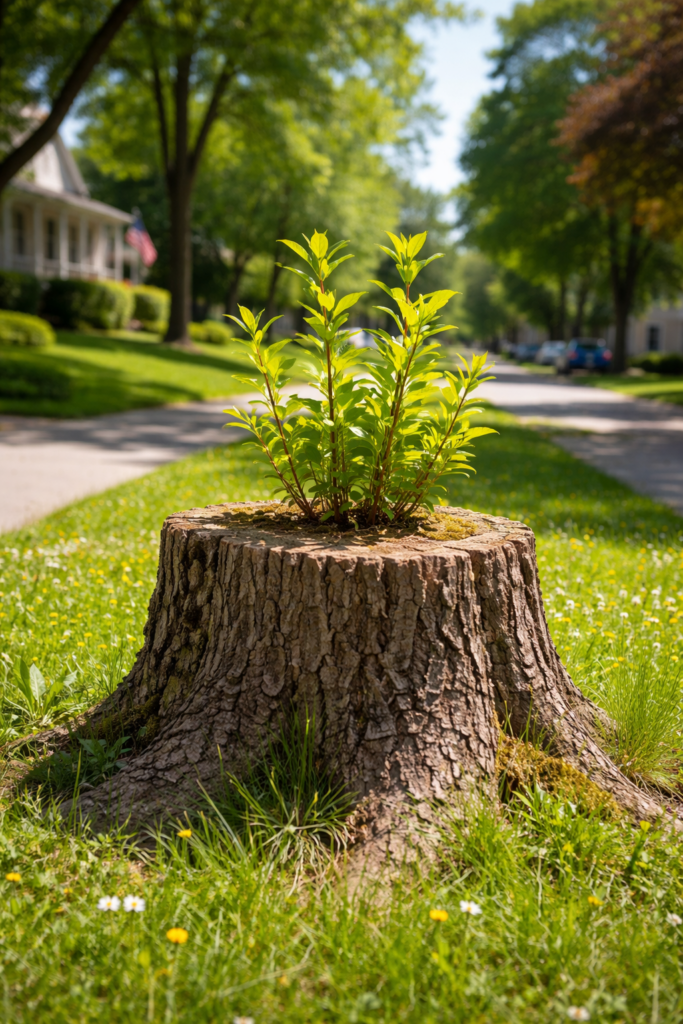
When a tree is cut down, most homeowners consider the job done once the trunk hits the ground. What many don’t realize, however, is that the stump and root system left behind are biologically wired to try again, often aggressively. That’s why a freshly cut stump can look dormant one week and covered in new shoots the next.
Stopping a tree stump from sprouting new growth isn’t just about aesthetics. If left untreated, stump regrowth can:
- Create unsightly sucker shoots throughout your yard
- Draw resources from nearby plants
- Lead to new trees forming where you don’t want them
- Erode soil structure as the stump continues to live underground
Let’s break down why stumps sprout, what actually kills them, and when DIY stops being effective and professional care matters.
The Biology of Regrowth: Why Stumps Sprout Epicormic Shoots After Felling
When you see new shoots climbing out of a cut stump or from the surrounding root zone, you’re seeing something rooted deep in tree physiology.
Living trees constantly balance energy produced through photosynthesis in leaves with storage in their roots. One of the key regulators in this system is a hormone called auxin. Auxin is produced in the live crown (the leaves and shoots) and sent downwards, suppressing dormant buds in the stump and root collars. When the crown is removed, so is that inhibitory signal. Dormant buds suddenly become active, and the stump sends up epicormic shoots in an attempt to regenerate a leafy canopy.
Two biological facts are critical here:
- Stumps don’t die immediately just because they’ve been cut. The cambium layers beneath the bark and the root systems still have stored energy and viable tissue capable of initiating new growth.
- New shoots are not random “volunteers.” They’re a survival mechanism, a tree’s programmed response to try and re-establish a canopy that was functioning just moments before.
That’s why just mowing or leaving the stump isn’t enough. To stop regrowth, all living tissues with access to stored energy must be neutralized either biologically or mechanically.
Don’t forget to check out: Stump Grinding vs. Stump Removal: Which Is Right for Your Yard?
Chemical vs. Natural Solutions: Choosing the Right Stump Killer for Your Yard
When homeowners talk about “killing a stump,” they’re really referring to stopping regrowth and eventually killing the root system. Two broad approaches are available:
Chemical Stump Treatment: Effective, Technical, and Targeted
Professional stump killers are formulated with systemic herbicides such as glyphosate or triclopyr. These compounds are absorbed into the living tissues and transported down into the roots, disrupting internal processes necessary for regrowth and survival.
Key technical steps for chemical treatment:
- Freshly exposed living tissue: Cut the stump as close to ground level as possible and drill multiple holes several inches deep to expose the cambium layer.
- Apply immediately after cutting: The window before the wound begins to seal is short, apply herbicide within minutes of making the final cut.
- Use proper chemical agents: Glyphosate is water-soluble and best applied to very fresh cuts. Triclopyr ester with an oil carrier penetrates drier wood more effectively when treatment is delayed.
- Avoid damage to surroundings: Systemic chemicals can harm nearby trees and plants if absorbed through shared root systems. Professional application minimizes risk and environmental impact.
Chemical stump killers work by disabling the stump’s ability to send water and nutrients to new shoots, essentially cutting off its internal life support. That’s why stopping regrowth is more than removing shoots above ground; the entire root network must be addressed.
Natural (Non-Chemical) Methods: Slower, Often Incomplete
Not every stump responds quickly to chemicals, and not every homeowner wants to use herbicides. There are non-chemical options, but they are slower and often depend on exhausting the stump’s stored energy over time rather than “killing” it outright:
- Starvation (Light/Oxygen Deprivation): Covering the stump with a tarp, heavy mulch, or black plastic blocks sunlight and oxygen, weakening living tissues over months.
- Epsom salt or desiccants: Drilling holes and packing them with magnesium sulfate draws moisture out of the stump and speeds internal tissue breakdown.
- Smothering and regular cutting: Continual removal of new shoots before they leaf out forces the stump to deplete stored carbohydrates, slowing regrowth and eventually exhausting energy reserves.
- Fungi and decomposition: Introducing wood-decomposing fungi accelerates rot organically, though this is not fast and may take years.
All of these can work, but they require persistence, time, and careful monitoring. And even then, they may only reduce regrowth rather than prevent it completely. That’s an important distinction when your goal is a stump that won’t come back.
The “Starvation” Method: Using Light Deprivation to Kill Stubborn Root Systems
Light deprivation, sometimes called “starvation,” is a well-understood natural approach used in turf and forest management when chemical treatments must be avoided.
The concept is simple: plants require sunlight to photosynthesize, which creates the sugars that feed their root systems. A stump without sunlight cannot sustain new leaf growth, meaning it must repeatedly draw on stored reserves. Without replenishment, those reserves deplete over multiple seasons.
Key components of starvation:
- Complete coverage: Light must be blocked entirely. A loosely draped tarp won’t suffice; edges must be sealed, overlaps secured, and roots covered if they are exposed.
- Extended time frames: Unlike chemical treatments that can act in weeks, starvation might take several months to over a year, depending on stump size and tree species.
- Monitor for breaches: Any breach in the cover, torn plastic, lifted edges, or water pooling can allow sunlight back in and restart photosynthesis.
While starvation is a valid tool in stump control, it is not a quick fix, and it doesn’t address large or deeply rooted systems as reliably as professional mechanical or chemical intervention.
Long-Term Prevention: When to Opt for Professional Stump Grinding and Excavation
If your stump is still sprouting despite repeated treatment or if you need complete and permanent prevention, stump grinding and excavation are the only guaranteed solutions.
Here’s why:
Mechanical Removal Eliminates the Source
Stump grinding involves specialized machinery that shaves the stump down below ground level, usually several inches to a foot deep, depending on species and root spread. By severing the cambium layer and large root structures, the mechanism prevents further regrowth and exhausts the storage zone that fuels sucker shoots.
A few technical reasons professionals are essential here:
- Depth matters: Grinding just at ground level leaves active tissues behind. Pro services grind below grade to break root continuity.
- Root systems vary: Some species have aggressive lateral roots that can keep sending up shoots even if the stump itself is treated. Professionals identify these and remove them.
- Safety and equipment: Stump grinders are heavy, powerful machines. Improper use can damage lawns, underground utilities, or injure operators. Trained crews minimize this risk.
Excavation for Maximum Control
In some cases, especially where stumps are close to structures or utility lines, excavation may be better than grinding alone. This involves removing not just the stump but major root sections from the surrounding soil. While more labor-intensive, it ensures the lowest possible chance of regrowth.
Professionals also provide:
- Assessment of soil and root zones
- Identification of suckering species (like willow, elm, or poplar)
- Safe removal near landscape features and buildings
If stump regrowth is persistent, that’s often a red flag: the root system is still alive underground, and partial treatments, whether natural or chemical, won’t stop future sprouts.
Final Thoughts: Smart Yard Care Means Professional Decisions
Stopping a stump from sprouting new growth isn’t just an aesthetic choice, it’s a biological and mechanical problem.
Here’s what every homeowner should understand:
- Tree stumps sprout because the root system is still biologically active. Cutting the trunk doesn’t stop the physiology beneath.
- Chemical and natural methods can reduce sprouts, but they require precision, timing, and often repeated applications.
- Starvation, drenching, and salts work slowly and may not eliminate root activity.
- Stump grinding and professional removal address the problem at its source, the cambium layer and root system, offering the most reliable prevention of regrowth.
If your yard has stumps that continue to send up shoots, or if you’re planning a removal and want zero chance of return, relying on professional Stump and Tree Removal Services is the clear choice. Contact Tree Solutions for a comprehensive assessment and long-term coverage because when it comes to controlling stump regrowth, there’s no substitute for expertise.
Don’t forget to check out our business profile: Tree Solutions LLC