
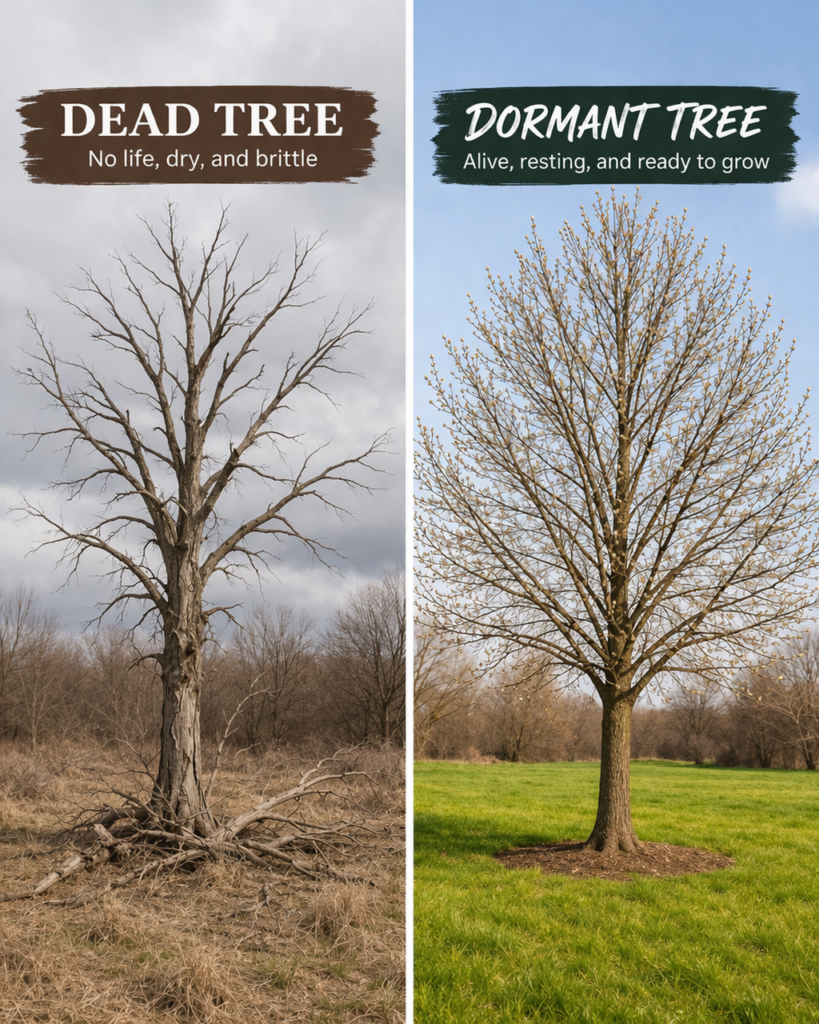
Few things worry homeowners more than stepping outside and noticing that a once-healthy tree suddenly looks lifeless.
Maybe the leaves never appeared this year.
Maybe the branches look brittle or dry.
Or maybe the tree simply looks still.
Before assuming the worst, there’s an important question to ask:
Is the tree actually dying, or is it just dormant?
Trees go through natural seasonal cycles, and during certain times of the year, they can appear completely lifeless even when they’re perfectly healthy. Dormancy is a built-in survival strategy that allows trees to conserve energy and survive unfavorable conditions like cold weather or drought.
The challenge is that a dormant tree and a dying tree can look very similar at first glance.
Understanding the difference is important not only for the health of the tree but also for the safety of your property. A dormant tree will bounce back once conditions improve. A dying tree, however, may become unstable and eventually dangerous if left untreated.
Here are the most reliable ways to tell the difference.
Understanding Tree Dormancy
Before diagnosing a problem, it helps to understand what dormancy actually is.
Dormancy is a natural phase in a tree’s life cycle where growth temporarily slows or stops. During this time, the tree reduces its metabolic activity to conserve energy until conditions improve.
This is especially common in deciduous trees, which lose their leaves during fall and remain bare throughout winter.
To someone unfamiliar with tree biology, a dormant tree may look completely dead. Branches are bare, growth stops, and the canopy appears lifeless.
But internally, the tree is still alive.
The root system continues working slowly beneath the soil, and the tree stores energy that will later fuel new buds, leaves, and growth when temperatures rise.
Because of this natural cycle, timing matters when evaluating tree health. A tree that looks dead in January may simply be resting until spring arrives.
Sign #1: Perform the Scratch Test
One of the most reliable ways to check if a tree is alive is something arborists call the scratch test.
Beneath the outer bark of a tree lies a thin layer called the cambium, which acts like the tree’s circulatory system. This layer transports water and nutrients throughout the tree.
Here’s how to perform the test:
- Choose a small branch or section of bark.
- Gently scratch the surface with your fingernail or a knife.
- Look at the layer underneath.
If the layer beneath the bark is green and moist, the cambium is still alive, and the tree is likely dormant.
If the tissue appears brown, gray, or dry, that section of the tree may be dead.
To be sure, check several areas of the tree. Sometimes, only a few branches die while the rest of the tree remains alive.
This simple test is one of the most widely used methods for determining whether a tree is dormant or truly dying.
Sign #2: Test the Flexibility of the Branches
Another simple way to assess tree health is to check the flexibility of its smaller branches.
Healthy branches usually contain moisture and living tissue, which allows them to bend slightly when pressure is applied.
Dead branches, however, tend to be brittle.
Try gently bending a small twig.
- If it bends without snapping, the branch is likely alive.
- If it breaks easily and reveals dry wood inside, that branch may be dead.
Dead wood loses moisture and structural strength over time, which is why it becomes fragile and easy to snap.
Keep in mind that a few brittle branches don’t necessarily mean the entire tree is dying. Many trees naturally shed small limbs over time.
However, large amounts of brittle branches throughout the canopy can signal serious decline.
Don’t forget to check out:
Who Offers Professional Tree Trimming Services in Macomb and Oakland Counties, Michigan
Sign #3: Look for Bud Development
Buds are another important indicator of tree health.
During late winter or early spring, healthy trees begin forming buds along their branches. These buds eventually develop into leaves or flowers.
If you examine the branches closely, you may notice small bumps or cone-shaped growths forming at the tips.
These are early signs that the tree is preparing for a new growing season.
Dormant buds typically appear:
- Firm
- Intact
- Slightly swollen
In contrast, a dying tree may show dry, shriveled buds or no buds at all.
If spring arrives and nearby trees begin leafing out while your tree remains completely bare, it could be a sign that something is wrong.
Still, patience is important. Some species naturally leaf out later than others.
Sign #4: Examine the Bark
The bark of a tree can reveal a lot about its overall health.
Healthy bark usually appears:
- Firm and intact
- Evenly colored
- Securely attached to the trunk
When a tree begins to decline, the bark often starts showing signs of distress.
Some warning signs include:
- Large sections of bark are peeling off
- Deep cracks along the trunk
- Soft or spongy areas
- Discolored patches
Trees rely on the bark and cambium layers to transport nutrients and water throughout the structure. When these systems become damaged, the tree’s ability to survive may be compromised.
Severe bark damage can also expose the tree to pests and disease.
Sign #5: Check for Fungal Growth
Fungi growing on or around a tree may indicate internal decay.
Mushrooms or shelf-like fungi that appear near the base of the trunk often develop when wood inside the tree begins to break down.
These organisms feed on decaying organic matter, which means structural damage may already be occurring inside the tree.
While not every fungus means a tree will fall immediately, it is usually a warning sign that the tree is under stress.
Internal decay weakens the structural integrity of the trunk and branches, making them more vulnerable to breaking during storms.
Sign #6: Watch for Structural Changes
Another sign that a tree may be dying is a sudden structural change.
For example:
- The tree begins leaning more than before
- Roots become exposed or lifted from the soil
- The ground around the trunk begins cracking
- The trunk develops large splits
These symptoms often indicate that the root system is weakening.
Roots anchor the tree in the soil and supply it with water and nutrients. If they become damaged or diseased, the tree can lose its stability.
Once a tree begins leaning significantly, the risk of falling increases, especially during strong winds or heavy storms.
Why Dying Trees Can Become Dangerous
When a tree starts dying, the problem isn’t just cosmetic.
Dead or declining trees gradually lose structural strength. Over time, branches may fall unexpectedly, or the entire tree may collapse.
This can lead to serious problems such as:
- Property damage to roofs, fences, or vehicles
- Blocked driveways or sidewalks
- Interference with power lines
- Injury to people nearby
Dead wood becomes brittle and fragile, making it far more likely to break during storms or heavy winds.
Because of this, trees that show multiple signs of decline should be evaluated before they become a safety hazard.
When It’s Time to Have the Tree Evaluated
Even with careful observation, it’s not always easy for homeowners to determine the exact condition of a tree.
Trees can sometimes appear healthy on the outside while internal decay weakens the trunk or root system.
Professional Arborists are trained to assess factors like:
- Structural stability
- Disease or pest damage
- Root health
- Overall tree vitality
In some cases, proper trimming or care can help a struggling tree recover. In other situations, removal may be the safest option to prevent property damage or injuries.
Early evaluation often prevents bigger problems later.
Final Thoughts: Don’t Wait Until It Becomes a Hazard
A dormant tree may look lifeless for a while, but a dying tree often shows clear warning signs: brittle branches, peeling bark, fungal growth, or no new buds during the growing season.
When these signs appear together, it’s important not to ignore them. Dead or declining trees can become structurally weak, meaning branches or even the entire tree can fall without warning and cause serious damage to homes, vehicles, or people nearby.
Instead of guessing whether your tree is dormant or dying, the safest step is to have it evaluated by a certified Arborist who understands tree health and safe removal practices.
Think your tree might be dying? Don’t wait for falling branches to decide for you. Contact the experts at Tree Solutions LLC for a professional inspection and safe tree removal when needed.
Don’t forget to check out our business profile: Tree Solutions LLC