
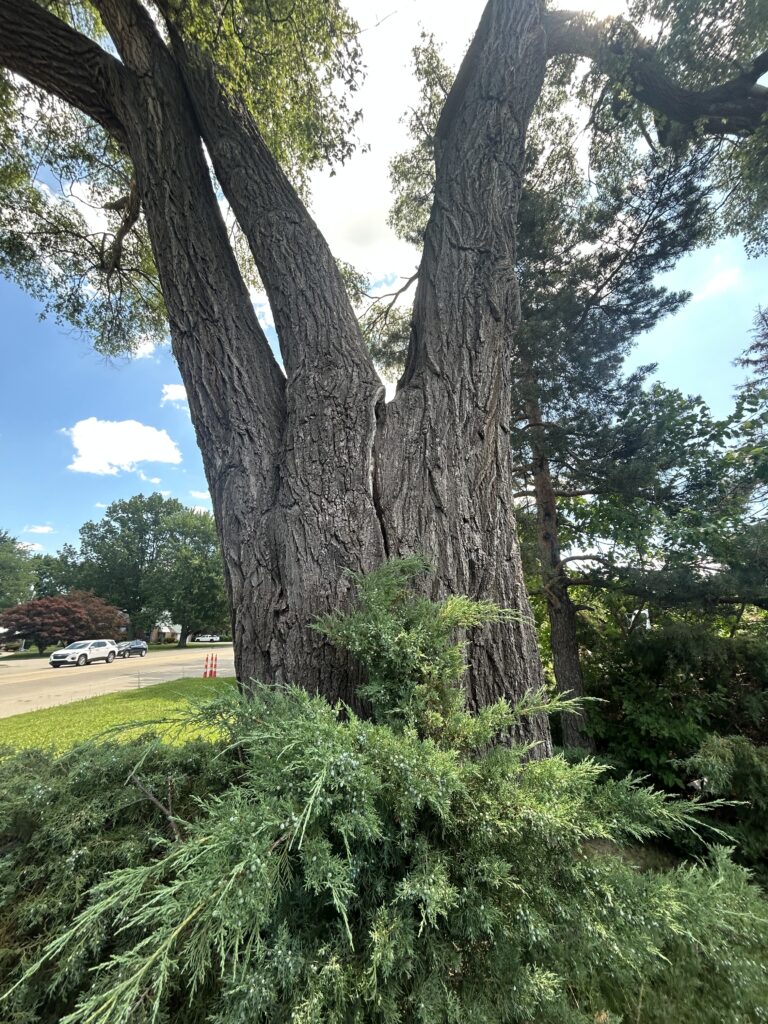
When most homeowners think about dangerous trees, they picture obvious problems: dead branches, leaning trunks, or visible decay. But many of the most serious structural hazards inside trees aren’t immediately visible from the ground.
One of the most common hidden structural defects found in landscape trees is co-dominant stem attachment.
At first glance, a tree with two large trunks growing side by side may appear perfectly healthy. The canopy may be full, the leaves vibrant, and the tree may have stood strong for decades without issues.
However, arborists know that this structure often creates one of the weakest points in a tree’s architecture.
As storm season approaches, this weakness becomes especially important. Strong winds, heavy rain, and saturated soil dramatically increase stress on trees. When structural defects like co-dominant stems exist, storms can quickly expose them, sometimes leading to sudden splitting or major limb failure.
Understanding what co-dominant stems are, how they form, and why they become dangerous during severe weather can help homeowners make smarter decisions about tree care and property safety. Professional inspections from experienced arborists, like the team at Tree Solutions LLC, can identify these risks early and prevent costly damage later.
What Are Co-Dominant Stems?
A co-dominant stem occurs when a tree develops two or more main trunks of equal or similar size that grow from the main parent stem.
Instead of one strong central trunk with supporting branches, the tree splits into multiple leaders that compete for dominance and lacks a branch union on the interior.r
This growth pattern is surprisingly common in urban and residential landscapes.
According to arboriculture research, co-dominant stems often create narrow V-shaped branch unions, which typically indicate a structural weakness within the tree.
The biggest concern with this structure is something known as included bark.
Included bark occurs when bark becomes trapped between the two stems as they grow. Rather than forming a solid union, the bark acts as a separating layer between the trunks.
Because bark does not provide structural support like wood fibers do, the connection between the stems remains weak throughout the life of the tree.
Over time, this weak union becomes a natural fault line.
Why Co-Dominant Stems Become More Dangerous During Storm Season
Trees experience environmental stress throughout the year. But storms dramatically increase the forces acting on a tree’s structure.
Wind, rain, and snow create pressure that can expose hidden weaknesses inside the trunk or canopy.
Co-dominant stems are particularly vulnerable because each stem acts like a competing lever pulling against the other.
1. Wind Forces Pull the Stems in Different Directions
During strong winds, each stem catches airflow independently.
Instead of bending together like a single trunk, the stems move in slightly different directions. This movement places tremendous stress on the narrow connection where the stems meet.
Research in arboriculture shows that tree failures frequently occur at the junction between co-dominant stems, especially when bark is present.
When the stress becomes too great, the union can crack or split suddenly.
And when a large stem fails, it often breaks off with significant weight and force.
2. Rain and Snow Add Massive Weight to the Canopy
Storms rarely bring just wind.
Heavy rain, snow, or ice accumulation can significantly increase the load on tree branches.
Wet leaves alone can add hundreds of pounds to a mature canopy. Snow and ice can increase that weight even further.
When two large stems share a weak connection, the added weight can cause the union to split apart.
This is one reason homeowners often discover broken tree trunks immediately after severe storms.
3. Co-Dominant Stems Become More Hazardous as Trees Mature
A small tree with co-dominant stems may remain stable for years.
But as the tree grows, both stems increase in height, diameter, and weight.
The pressure inside the union grows with every year of growth.
Eventually, the structural defect becomes significant enough that a strong wind event can trigger failure.
In many cases, the tree has been developing this weakness silently for decades.
Storm season simply exposes the problem.
The Role of Included Bark in Tree Failure
Included bark plays a major role in the structural weakness of co-dominant stems.
In a healthy branch attachment, wood fibers from the trunk and branch grow together and interlock. This creates a strong connection capable of supporting significant weight.
With co-dominant stems, that interlocking wood structure often never develops.
Instead, bark grows between the stems and prevents the formation of a strong union.
Studies examining the strength of these junctions found that co-dominant stems containing included bark are significantly weaker than those without it.
As the stems expand, they press against each other like wedges. This pressure can gradually force the stems apart internally.
When the tree eventually splits, the included bark becomes clearly visible along the separation line.
Warning Signs Homeowners Should Watch For
Identifying co-dominant stems early can help prevent serious property damage.
Some structural warning signs are easy to spot from the ground.
Two Large Trunks Emerging From the Same Point
If a tree splits into two equally sized trunks near the base or main canopy, it likely has co-dominant stems.
A Narrow “V”-Shaped Branch Union
Healthy branch attachments usually form a wider U-shaped connection.
Co-dominant stems often create a tight V-shaped union, which is more prone to structural failure.
Visible Cracks Between the Stems
If you notice cracks forming between the trunks or large branches, it may indicate that the union is already weakening.
This type of damage should be inspected immediately.
Bark Seams Running Down the Attachment
Sometimes the included bark creates a visible seam running down the center of the union.
This seam is a sign that the stems never formed a solid structural bond.
Why DIY Tree Trimming Doesn’t Solve the Problem
Many homeowners assume that trimming a few branches will reduce the risk associated with co-dominant stems.
Unfortunately, improper pruning can actually make the problem worse.
Removing large branches from one stem can shift weight distribution throughout the canopy. This sudden imbalance may increase pressure on the weak union rather than relieving it.
Structural tree issues require careful evaluation of the entire tree, including canopy balance, stem diameter ratios, and overall health.
Professional arborists are trained to assess these factors before making pruning decisions.
How Arborists Reduce the Risk of Co-Dominant Stem Failure
Fortunately, several professional techniques can reduce the risk associated with co-dominant stems.
The best solution often depends on the tree’s age, location, and overall structural condition.
Structural Pruning
When trees are young, arborists can perform structural pruning to encourage the development of a single dominant trunk.
Early pruning helps prevent co-dominant leaders from forming in the first place.
Crown Reduction
For mature trees, reducing the weight of competing stems can decrease stress on the union.
This involves carefully shortening specific branches to reduce leverage during storms.
Cabling and Bracing
In valuable or historic trees, arborists sometimes install support systems such as steel cables or braces between stems.
These systems help distribute wind forces and prevent sudden splitting.
Tree Removal When Necessary
If a large tree with co-dominant stems is located near a home or structure, removal may be the safest option.
Professional crews can safely remove hazardous trees while protecting nearby buildings and structures.
Why Professional Inspections Matter Before Storm Season
Trees are often the largest living structures on residential properties.
When they fail, the damage can be severe, including crushed roofs, broken vehicles, blocked driveways, or downed power lines.
Yet many tree hazards remain unnoticed until severe weather strikes.
Routine inspections by experienced arborists can identify structural defects long before they become emergencies.
Final Thoughts: Strong Trees Depend on Strong Structure
Trees bring beauty, shade, and environmental benefits to residential landscapes. But their safety depends heavily on the strength of their structure.
Co-dominant stem attachments are one of the most common structural weaknesses found in mature trees. Because the defect often develops slowly and invisibly, many homeowners don’t recognize the risk until storm damage occurs.
High winds, heavy rain, and added canopy weight can place tremendous stress on these weak unions. When failure happens, it often involves large sections of the tree splitting apart suddenly.
The good news is that many of these problems can be identified and managed long before they become dangerous.
If you’re preparing your property for the upcoming storm season, having your trees evaluated by experienced professionals like Tree Solutions LLC can make a major difference. Their trained arborists understand how to identify structural defects such as co-dominant stems and recommend solutions that protect both your trees and your property.
Because when it comes to storm safety, the strongest defense often starts with preventative maintenance and understanding the structure of the trees around your property.
Don’t forget to check out our business profile: Tree Solutions LLC