
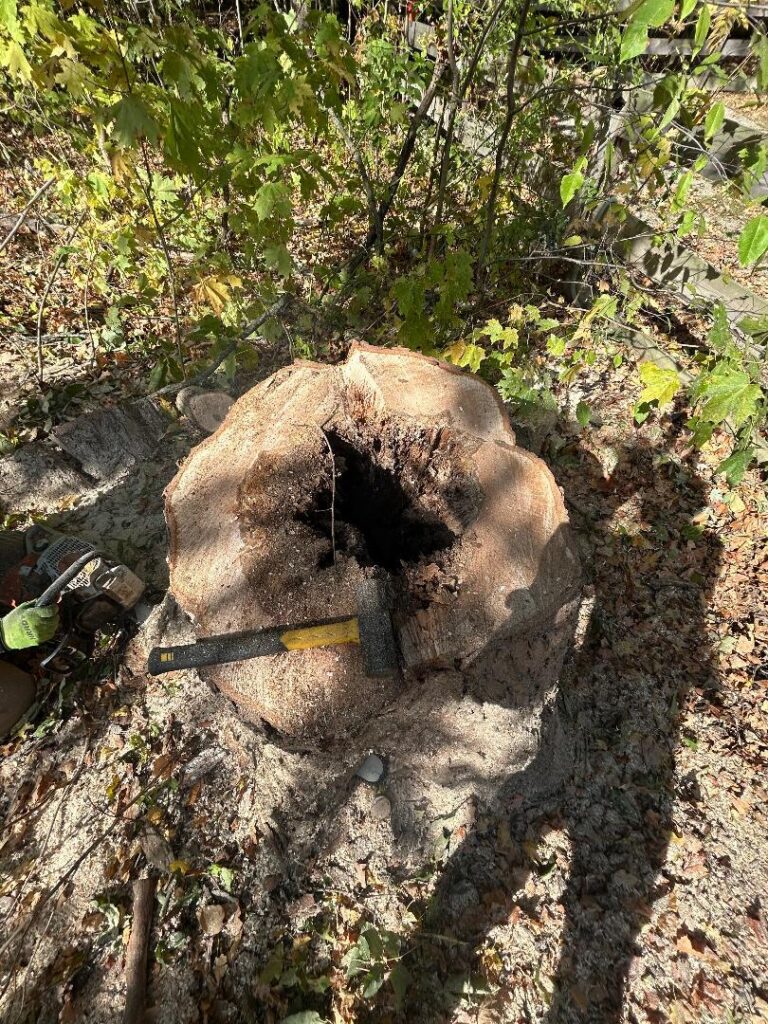
Most homeowners breathe a sigh of relief when a tree is finally removed. The hazardous limbs are gone, the trunk has been cut down, and the yard looks safer and cleaner.
But what happens next is often overlooked.
The remaining stump may seem like a minor issue, something that can be dealt with later. In reality, an untreated stump can become a biological hotspot for wood-decaying fungi, termites, carpenter ants, beetles, and other organisms that thrive on dead wood. Over time, it can also create landscape problems, contribute to tree disease issues, and attract unwanted pest activity.
For Michigan property owners, where seasonal moisture, snowmelt, and humid summers accelerate decomposition, proper stump management is more important than many people realize.
The question isn’t simply whether a stump looks bad. The real question is whether leaving it behind could create bigger problems in the future.
Why Tree Stumps Don’t Just “Sit There”
Once a tree is cut down, decomposition begins immediately.
A stump remains connected to a network of roots underground, and the exposed wood starts interacting with its environment. Moisture enters through cracks and exposed surfaces, fungi colonize the wood, and insects begin taking advantage of a new food source.
According to research from the USDA Forest Service, wood-degrading organisms primarily include fungi, insects, bacteria, and other biological agents that break down wood over time. Fungi are particularly important because they use wood as a food source and thrive when moisture, oxygen, and suitable temperatures are present.
In a natural forest, this process is beneficial. Dead wood recycles nutrients back into the ecosystem and supports biodiversity.
In a residential landscape, however, that same process can create issues homeowners would rather avoid.
Why Michigan’s Climate Accelerates Stump Decay
Michigan provides nearly ideal conditions for wood decomposition.
Several environmental factors contribute:
Frequent Moisture
Rainfall throughout much of the year keeps stumps damp and encourages fungal growth.
Snow and Spring Melt
Winter snowpack and spring thaw introduce additional moisture directly into exposed wood fibers.
Humid Summers
Warm temperatures combined with humidity create favorable conditions for fungal colonization.
Saturated Soil Conditions
Many Michigan properties experience periods of soil saturation that can keep root systems moist long after a tree is removed.
The USDA Forest Service notes that wood-decay fungi require moisture, oxygen, and moderate temperatures to grow, all conditions commonly found in Michigan landscapes.
The Science Behind Fungal Growth on Tree Stumps
One of the first things that happens after tree removal is fungal colonization.
Many homeowners notice mushrooms growing near old stumps and assume the mushrooms are the problem.
They are actually symptoms.
The real fungal activity occurs inside the wood itself.
Research from the USDA Forest Service explains that wood-decay fungi break down the structural components of wood to obtain nutrients. As decomposition progresses, fungi gradually weaken wood fibers and alter the physical structure of the stump.
Common signs of fungal colonization include:
- Mushrooms around the stump
- Shelf or bracket fungi
- Soft or spongy wood
- Cracking and splitting
- Dark discoloration
- Musty odors
These signs indicate that decomposition is actively occurring.
Can Fungi Spread From a Stump to Other Trees?
This is one of the most important questions homeowners ask.
The answer is: sometimes.
Not all fungi are harmful to nearby trees. Many simply decompose dead wood and remain confined to the stump.
However, certain root diseases and decay organisms can move through root contact or root grafts between trees.
Forest pathology experts note that some root diseases spread from tree to tree through underground root connections, allowing pathogens to move between neighboring trees.
This is especially concerning in landscapes where:
- Trees are closely spaced
- Mature trees share root zones
- Disease was present before removal
- Multiple trees belong to susceptible species
A neglected stump can potentially serve as a reservoir for pathogens long after the original tree has been removed.
Why Termites Are Attracted to Old Tree Stumps
The connection between tree stumps and termites is well documented.
Termites depend on cellulose, the primary structural component found in wood.
Dead stumps provide exactly what termites need:
- Food
- Moisture
- Shelter
- Protection from predators
Research and pest management sources consistently identify dead wood and stumps as common termite habitats. As wood begins to decay, it becomes easier for termites to consume because fungal activity softens the wood structure.
This is why old stumps frequently become active feeding sites.
Does a Tree Stump Mean Your House Will Get Termites?
Not necessarily.
This is where many homeowners misunderstand the risk.
A stump does not automatically cause a home infestation.
However, it can increase termite activity on your property.
Think of an untreated stump as a resource that encourages termites to remain nearby.
Pest experts note that termite colonies often establish themselves in dead wood and root systems before expanding their foraging range. While a stump is not a guarantee of structural infestation, it can support termite populations close to buildings.
The closer the stump is to a structure, the greater the concern.
Carpenter Ants Love Decaying Stumps Too
Termites are not the only insects attracted to decomposing wood.
Carpenter ants frequently establish colonies in:
- Rotten stumps
- Decaying logs
- Dead root systems
Unlike termites, carpenter ants do not eat wood.
Instead, they excavate it to create nesting chambers.
The USDA Forest Service identifies carpenter ants among the insects commonly associated with wood deterioration and decaying wood environments.
Their presence often indicates that significant decay has already occurred.
The Hidden Problem Underground
Most people focus on the visible stump.
The larger issue often exists below ground.
Even after removal, root systems can persist for years.
As roots decay:
- Soil settles
- Voids form underground
- Surface depressions develop
- Drainage patterns change
Large root systems may take many years to completely decompose.
Homeowners frequently notice:
Uneven Lawns
The ground begins sinking where roots once occupied space.
Water Collection Areas
Low spots may retain moisture after rainfall.
Landscape Instability
Future planting projects can become more difficult.
Hardscape Issues
Settling soil can affect nearby sidewalks, patios, and landscape features.
These issues often appear gradually, making them easy to overlook until repairs become necessary.
Why Some Stumps Keep Producing New Growth
Many tree species attempt to survive after removal.
Instead of dying immediately, they send up new shoots from the stump or roots.
Common species known for vigorous sprouting include:
- Maple
- Elm
- Poplar
- Willow
While these shoots may look healthy initially, they rarely develop into structurally sound trees.
Instead, homeowners often find themselves trapped in a cycle of repeatedly cutting back unwanted growth.
Proper stump removal helps eliminate this ongoing maintenance issue.
Common Homeowner Mistakes After Tree Removal
Leaving the Stump Indefinitely
The most common mistake is simply ignoring it.
The longer a stump remains, the greater the opportunity for pests and fungi to establish themselves.
Covering It With Mulch
This hides the stump visually but often traps moisture and accelerates decay.
Using DIY Chemicals Incorrectly
Improper chemical treatments may damage surrounding vegetation while failing to address the actual problem.
Assuming Decay Is Harmless
Decay is natural, but in a residential landscape, it can create risks that extend beyond the stump itself.
Why Professional Stump Grinding Is Often the Best Solution
Professional stump grinding removes the majority of the stump below ground level and significantly reduces future issues.
Benefits include:
Reduced Fungal Habitat
Removing wood limits opportunities for fungal colonization.
Less Pest Attraction
Termites, carpenter ants, and beetles lose a major food source.
Improved Property Appearance
The landscape becomes easier to maintain and redesign.
Elimination of Sprouting
Most regrowth problems disappear.
Better Long-Term Property Management
The area becomes available for turf, gardens, or future landscape projects.
While no solution can completely eliminate every biological activity underground, stump grinding substantially reduces the conditions that attract pests and decay organisms.
Why Professional Evaluation Matters
Not every stump presents the same level of risk.
Factors such as:
- Tree species
- Existing disease history
- Proximity to structures
- Soil conditions
- Moisture levels
- Property goals
All influence the best management strategy.
At Tree Solutions LLC, stump removal is viewed as more than a cosmetic service. Proper stump management helps reduce future pest activity, limits fungal colonization, improves landscape usability, and supports the long-term health of surrounding trees and property.
Final Thoughts
A tree stump may look like a harmless leftover after tree removal. Still, research shows that dead wood quickly becomes a resource for fungi, insects, and other organisms that specialize in decomposition. The combination of moisture, cellulose, and shelter makes untreated stumps particularly attractive to termites, carpenter ants, and wood-decay fungi.
In Michigan’s moisture-rich climate, decomposition happens faster than many homeowners expect. What begins as a small stump can eventually contribute to pest activity, fungal growth, soil settling, unwanted sprouts, and landscape maintenance challenges.
Removing a tree is only part of the process. Proper stump handling ensures that the problem does not continue underground long after the tree itself is gone.
For homeowners who want to protect their property, preserve landscape health, and avoid future headaches, addressing the stump is often just as important as removing the tree in the first place.