
Removing a tree may look simple from the ground. A homeowner sees a trunk, a chainsaw, and some open space, then assumes the job can be completed in a few hours. However, professional arborists know that tree removal is one of the most technically challenging and hazardous services in the tree care industry.
Every year, serious injuries and fatalities occur during tree trimming and removal operations. According to data from the Centers for Disease Control and Prevention (CDC), more than 1,200 workers died during tree care operations over a 15-year period, with the most common causes being falling trees or branches, falls from height, and electrocutions.
The reality is that tree removal involves far more than cutting wood. It requires risk assessment, structural analysis, specialized equipment, advanced rigging techniques, and extensive safety planning.
In this article, we’ll explore why homeowners often underestimate tree removal complexity and why hiring experienced professionals such as Tree Solutions LLC is often the safest and most cost-effective decision.
The Common Misconception: “It’s Just Cutting Down a Tree”
Many homeowners have successfully cut small saplings or removed shrubs from their property. That experience can create a false sense of confidence when dealing with mature trees.
The problem is that large trees behave very differently.
A 60-foot oak tree can weigh several tons. Its branches may extend over homes, garages, fences, driveways, utility lines, and neighboring properties. Once a cut is made, gravity takes over, and gravity rarely offers second chances.
Professional arborists spend years learning how trees respond to cuts, how weight shifts through a canopy, and how environmental factors influence the direction of a fall.
What looks like a straightforward project often becomes a highly engineered operation.
Every Tree Is Different
One of the biggest reasons homeowners underestimate tree removal is that no two trees are alike.
Tree removal plans vary based on:
- Species
- Height
- Diameter
- Age
- Health condition
- Lean angle
- Root stability
- Surrounding structures
- Weather conditions
For example, a healthy maple may behave predictably during removal. A lightning-damaged maple, however, could contain hidden decay and internal fractures that make it extremely unstable.
Professionals must evaluate these variables before making a single cut.
Without proper assessment, unexpected tree failure can occur, placing people and property at risk.
Hidden Structural Defects Are Often Invisible
A tree can appear healthy from the outside while suffering from significant internal damage.
Common hidden defects include:
- Internal decay
- Hollow trunks
- Root rot
- Lightning damage
- Insect infestations
- Cracked limbs
- Weak branch unions
These defects dramatically affect how a tree responds during removal.
For instance, a decayed trunk may split unexpectedly during cutting. A compromised limb may fail before workers are prepared for it.
This is why professional arborists perform thorough inspections before removal begins.
At Tree Solutions LLC, evaluating tree structure is a critical first step in every removal project.
Gravity Doesn’t Always Behave as Expected
One of the most dangerous misconceptions homeowners have is believing a tree will simply fall where they want it to.
Unfortunately, trees rarely cooperate.
Several factors influence the direction of a fall:
- Natural lean
- Uneven canopy weight
- Wind conditions
- Internal defects
- Ground slope
- Root instability
Even a slight miscalculation can cause a tree to fall in an unexpected direction.
In residential neighborhoods, that could mean:
- Roof damage
- Vehicle damage
- Fence destruction
- Utility line impacts
- Neighbor disputes
Professional crews use advanced cutting techniques, ropes, rigging systems, cranes, and controlled dismantling methods to manage these risks.
Working Around Power Lines Changes Everything
Power lines are among the most dangerous obstacles in tree removal.
The Occupational Safety and Health Administration (OSHA) identifies overhead power lines as one of the leading hazards in tree care operations. Electrocutions remain a significant cause of fatalities within the industry.
Homeowners often assume they can simply avoid touching the wires.
Unfortunately, electricity doesn’t work that way.
Branches, ropes, equipment, and even nearby conductive materials can create dangerous situations.
Trees growing near electrical infrastructure frequently require specialized procedures and coordination with utility companies.
This is not work that should ever be attempted without professional expertise.
The Equipment Is More Advanced Than Most People Realize
Many homeowners believe tree removal requires little more than a chainsaw.
Professional tree removal crews often use:
- Commercial-grade chainsaws
- Rigging systems
- Climbing equipment
- Aerial lifts
- Cranes
- Winches
- Lowering devices
- Wood chippers
- Stump grinders
- Personal protective equipment
Each piece of equipment requires training and experience.
Modern rigging systems, for example, allow crews to lower heavy branches safely without damaging nearby structures.
Without these tools, removing a tree in a confined residential space becomes significantly more dangerous.
Tree Climbing Is a Specialized Skill
Professional tree climbers undergo extensive training to work safely at height.
Tree climbing involves:
- Rope systems
- Harnesses
- Anchor points
- Weight distribution
- Fall protection
- Emergency rescue procedures
Research examining tree-care fatalities found that falls remain one of the leading causes of death in the industry.
Many homeowner accidents occur because people attempt removals using ladders.
Ladders and chainsaws are a notoriously dangerous combination.
A ladder can shift, a branch can swing unexpectedly, or the tree itself can move during cutting.
Professional arborists are trained to avoid these hazards through specialized climbing techniques.
Weather Plays a Bigger Role Than Most Homeowners Think
Tree removal is heavily influenced by environmental conditions.
Professionals monitor:
- Wind speed
- Wind direction
- Rainfall
- Snow load
- Ice accumulation
- Soil moisture
A tree that appears stable on a calm day may become unpredictable during high winds.
Storm-damaged trees are especially hazardous because internal fractures may not be visible from the ground.
Even experienced crews modify their removal strategies when weather conditions change.
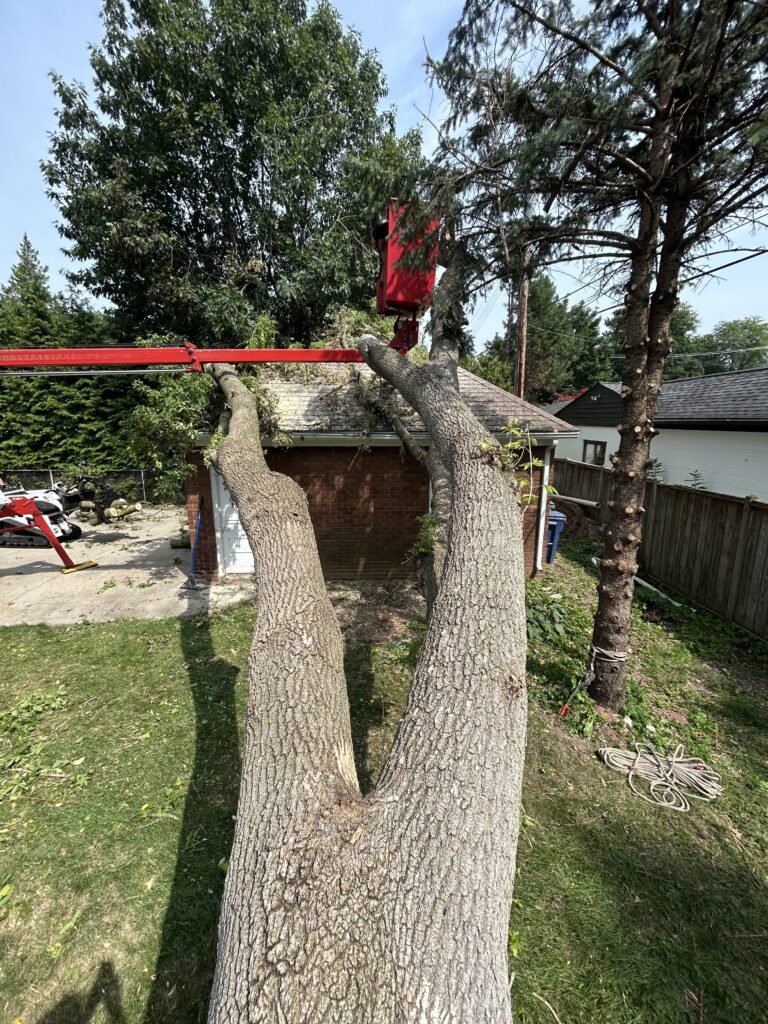
Limited Space Increases Complexity
Many residential removals occur in tight spaces.
Consider a typical suburban property:
- House on one side
- Fence on another
- Garage behind
- Neighbor’s property nearby
In these cases, cutting down the whole tree is not an option.
Instead, crews must remove it piece by piece.
This process is called sectional dismantling.
Large limbs are carefully rigged, cut, and lowered to the ground under controlled conditions.
While homeowners often see only the final result, the planning and execution behind sectional removals require significant expertise.
Emergency Tree Removal Is Even More Complex
Trees damaged by storms, lightning, or high winds often create dangerous situations.
These trees may be:
- Partially uprooted
- Hung up in neighboring trees
- Split through the trunk
- Resting on structures
- Entangled in utility lines
The tension and compression forces within damaged trees can be difficult to predict.
One wrong cut can release enormous stored energy.
This is why emergency removals are typically handled by experienced professionals using specialized equipment and carefully planned procedures.
Tree Removal Is One of the Most Dangerous Trades
Many homeowners are surprised to learn just how hazardous tree work can be.
Research published in occupational safety studies consistently identifies tree care as a profession with elevated fatality risks due to falls, struck-by incidents, electrocutions, and equipment-related accidents.
Industry analyses have also shown that tree workers face significantly higher occupational fatality rates than many other professions.
These statistics highlight an important reality:
If trained professionals face substantial risks despite specialized equipment and experience, homeowners should approach DIY removals with extreme caution.
Why Professional Planning Matters
Before a professional removal begins, arborists typically evaluate:
Tree Condition
Assessing structural integrity, decay, and stability.
Site Conditions
Identifying obstacles, access points, and hazards.
Fall Zones
Determining safe removal areas.
Rigging Requirements
Planning controlled branch and trunk lowering.
Equipment Needs
Selecting appropriate tools and machinery.
Safety Procedures
Preparing emergency response and rescue plans.
Most homeowners never see this planning process, which is one reason tree removal appears deceptively simple.
How Tree Solutions Handles Complex Removals
At Tree Solutions LLC, tree removal is approached with safety, precision, and long-term property protection in mind.
Every project begins with a detailed assessment of:
- Tree health
- Structural condition
- Property layout
- Nearby hazards
- Removal objectives
Whether removing a storm-damaged tree, a lightning-struck maple, a hazardous dead oak, or a tree growing dangerously close to a structure, the goal is always the same:
Complete the removal safely while minimizing risk to people and property.
By combining professional expertise, specialized equipment, and proven removal techniques, Tree Solutions LLC helps homeowners avoid the costly mistakes that often accompany DIY tree work.
Final Thoughts
Tree removal is one of the most misunderstood services in property maintenance.
From the ground, it may appear to be nothing more than cutting down a tree. In reality, it is a highly technical process involving risk assessment, structural analysis, advanced equipment, safety planning, and precise execution.
The next time you see a tree removal crew working in a residential neighborhood, remember that what appears simple is often the result of years of training and careful planning.
When a tree becomes hazardous, storm-damaged, diseased, or structurally compromised, trusting experienced professionals like Tree Solutions LLC can protect your property, your investment, and most importantly, your safety.