
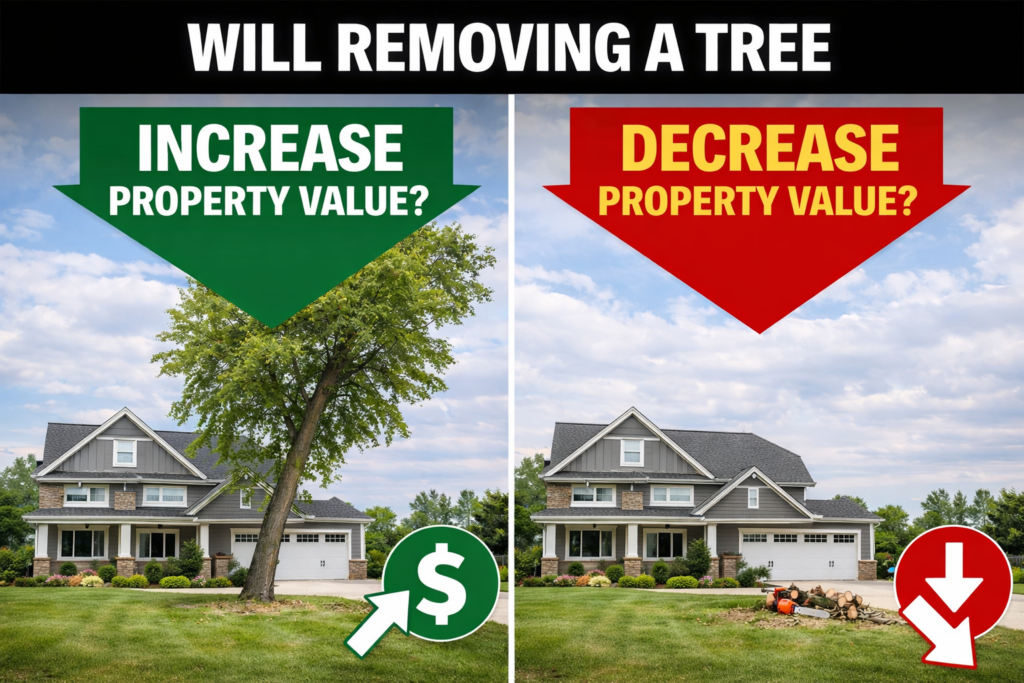
Trees are often one of the first things buyers notice about a property. They provide shade, improve curb appeal, reduce energy costs, and create a more attractive outdoor environment. In fact, decades of research consistently show that healthy, well-maintained trees can increase residential property values.
However, this doesn’t mean every tree should remain on your property. A diseased, dying, or structurally unstable tree can have the opposite effect. It may create safety concerns, increase maintenance costs, and discourage potential buyers. In these situations, removing the tree can actually protect, or even improve, your home’s market value.
So, will removing a tree increase or decrease your property value? The answer depends on the condition, location, and risk associated with the tree.
Healthy Trees Usually Add Value
Research has repeatedly found that healthy trees contribute positively to residential property values.
A 2022 meta-analysis in Ecological Economics reviewed 21 U.S. property value studies. It found that neighborhoods with more tree canopy often have higher home values. The researchers concluded that tree cover provides measurable economic benefits, particularly when trees are well-distributed throughout residential neighborhoods.
Similarly, a systematic review in Heliyon analyzed 89 studies from 21 countries. It found that more tree canopy, mature trees, and nearby urban forests often increased home values.
Healthy trees increase value because they offer several benefits:
- Improve curb appeal
- Provide shade that lowers cooling costs
- Reduce stormwater runoff
- Improve neighborhood aesthetics
- Increase privacy
- Help moderate outdoor temperatures
For homeowners planning to sell, mature healthy trees are often considered an asset rather than a liability.
When Tree Removal Can Increase Property Value
Although trees usually add value, not every tree benefits a property.
Sometimes removing a hazardous or poorly placed tree is actually the smarter financial decision.
1. The Tree Is Dead or Dying
Dead trees quickly become an eyesore.
More importantly, they become unstable over time. Falling branches or complete tree failure can cause expensive damage to roofs, vehicles, fences, and nearby structures.
Potential buyers often recognize these risks immediately.
Investing in tree removal services before listing a property demonstrates that the home has been properly maintained and eliminates concerns during inspections.
2. The Tree Is Structurally Unsafe
Trees with major defects can significantly reduce buyer confidence.
Common warning signs include:
- Large trunk cracks
- Hollow trunks
- Significant decay
- Leaning after storms
- Large dead limbs
- Root instability
These situations often require dangerous tree removal because delaying action increases safety risks.
Removing a hazardous tree can eliminate a major objection during the home-buying process.
3. The Tree Is Too Close to the House
Large trees growing only a few feet from a home’s foundation can create ongoing concerns.
Potential problems include:
- Roof damage from overhanging branches
- Foundation issues caused by roots
- Blocked gutters
- Moisture retention
- Pest access into the home
If a tree threatens the structural integrity of the property, removal may improve both safety and resale appeal.
4. Storm Damage Has Weakened the Tree
Michigan experiences heavy snowfall, ice accumulation, thunderstorms, and high winds that can weaken otherwise healthy trees.
After severe weather, trees with broken limbs, split trunks, or root damage may become hazardous.
Removing storm-damaged trees before they fail can prevent costly repairs and reassure future buyers that the property has been well maintained.
When Removing a Tree Could Decrease Property Value
Removing trees isn’t always beneficial.
If the tree is healthy, mature, and properly located, removal may actually reduce the property’s appeal.
Healthy trees contribute to:
- Attractive landscaping
- Shade
- Wildlife habitat
- Energy efficiency
- Privacy
- Neighborhood character
Research dating back several decades supports this conclusion.
One well-known study in Landscape and Urban Planning found that homes with mature trees sold for about 3.5% to 4.5% more.
This was compared to similar homes without mature trees. Larger, well-established trees contributed the greatest increase in property value.
Removing these valuable landscape features without a clear reason could make the property less attractive to prospective buyers.
The Importance of Professional Evaluation
One of the biggest mistakes homeowners make is assuming a tree should be removed simply because it’s large.
Size alone doesn’t determine risk.
Many mature trees remain structurally sound for decades with proper maintenance.
Professional inspections evaluate factors such as:
- Tree health
- Structural stability
- Root condition
- Disease
- Pest damage
- Branch attachment
- Overall risk
In many cases, tree trimming and removal services can address concerns without removing the entire tree.
Strategic pruning may eliminate hazardous limbs while preserving the tree’s health and the property’s value.
Location Matters More Than Most People Think
Research has shown that the location of a tree is almost as important as the tree itself.
A study in Urban Forestry & Urban Greening found that tree cover in a neighborhood often raises property values. Lot trees may raise values too, but usually less. Trees that improve the streetscape often raise home values, while poorly placed trees on private property may help less. They can also create maintenance concerns.
This explains why two seemingly similar trees can have very different impacts on resale value.
A healthy oak providing shade in the backyard is an asset.
A decaying maple leaning over the roof is a liability.
How Buyers View Trees
Today’s buyers generally appreciate mature landscaping, but they also pay close attention to potential maintenance costs.
Questions buyers often ask include:
- Is the tree healthy?
- Will it require expensive maintenance?
- Could it damage the roof?
- Are roots affecting the driveway?
- Is it close to power lines?
- Could it become a safety hazard?
Addressing these concerns before selling can improve buyer confidence and reduce negotiation issues.
Tree Removal Should Never Be Based on Appearance Alone
Some homeowners remove trees simply to create a larger lawn or modernize landscaping.
While this may suit personal preferences, removing healthy mature trees rarely guarantees a higher selling price.
Research consistently shows that trees provide measurable environmental and economic benefits, including cooling, air quality improvement, and increased neighborhood desirability. These factors often contribute positively to residential property values over time.
Before removing a tree, it’s worth considering whether proper pruning or maintenance could achieve the desired result while preserving its long-term value.
Choosing the Right Solution
Every property is different, which is why there is no universal answer to whether removing a tree increases or decreases value.
Generally:
- Keep healthy, well-positioned trees whenever possible.
- Remove trees that are dead, diseased, structurally unstable, or pose a safety risk.
- Consider professional inspections before making permanent decisions.
- Use tree removal services only when removal is the safest and most practical option.
- For high-risk situations, rely on experienced professionals trained in dangerous tree removal to protect nearby structures and landscaping.
Final Thoughts
Healthy, mature trees are among the most valuable landscape features a property can have. Numerous scientific studies have linked tree canopy with higher home values, improved curb appeal, and more desirable neighborhoods. However, not every tree adds value. Dead, diseased, storm-damaged, or poorly located trees can create safety hazards, increase maintenance costs, and discourage potential buyers.
The key is making informed decisions rather than removing trees unnecessarily. A professional assessment can determine whether pruning, maintenance, or complete removal is the best solution. When removal is necessary, investing in professional tree removal services helps protect your property, improve safety, and preserve long-term value.