
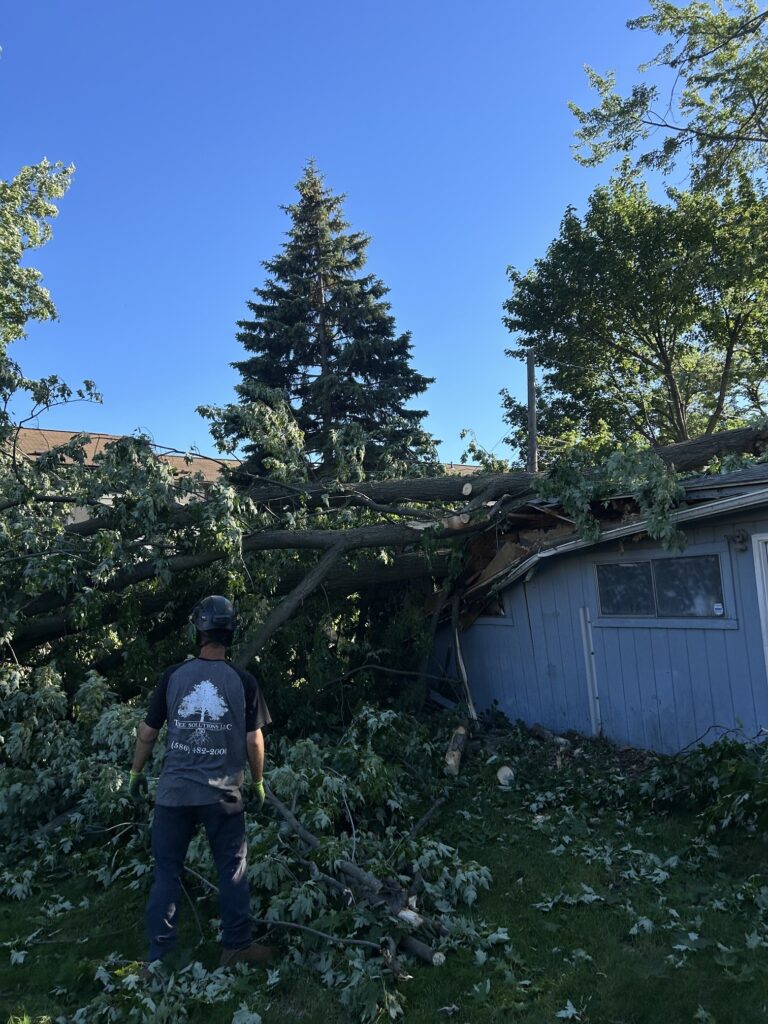
A mature tree can look solid and healthy for years, yet a single storm can turn it into a serious hazard. High winds, heavy snow, ice, saturated soil, disease, and structural defects can cause a tree or large branch to fail with little warning. When that happens, the damage can extend far beyond the tree itself.
A falling tree can damage a roof, crush a vehicle, break a fence, block a driveway, or bring down utility lines. Research on storm-related tree failures shows that wind speed, tree size, species, soil conditions, and structural defects all influence the likelihood of failure. In one study of trees hit by a major windstorm, larger trees were more likely to fail. Defects and site conditions also played an important role.
Understanding the potential damage is important, but knowing what to do before and after a tree falls is even more important.
How Falling Trees Cause Property Damage
The damage caused by a falling tree depends on its size, direction of fall, condition, and what is located underneath it. A small branch falling into an open yard may only create a cleanup problem. A mature tree falling toward a house can create a much more serious situation.
The force generated by a large trunk and branches can damage structural components that are not immediately visible. Roof decking, rafters, siding, windows, gutters, garages, sheds, and other structures may all be affected.
Research examining tree failures during severe winds has also shown that the consequences can extend beyond the tree itself. Tree failures can disrupt residential buildings, transportation systems, and electrical infrastructure, creating interconnected problems during major storms.
Damage to Homes and Other Structures
A tree falling onto a home is one of the most serious forms of tree-related property damage.
Even when the roof appears to have only minor damage, there may be problems underneath. A heavy trunk or large limb can damage roofing materials, framing, insulation, gutters, and ceilings. Rain can then enter through damaged areas and create additional moisture problems.
Other structures around a property can also be affected. Detached garages, sheds, barns, decks, patios, and outdoor structures may be damaged by falling trunks or branches.
This is one reason homeowners should avoid assuming that a tree simply needs to be cut into smaller pieces after it falls. The area should first be assessed for structural damage and other hazards.
Fences Are Particularly Vulnerable
Fences are among the first property features to suffer damage when trees or large branches fall near property boundaries.
A tree can:
- Crush sections of fencing
- Break posts
- Pull connected sections out of alignment
- Damage gates
- Destroy landscaping along the fence line
Fence damage may appear straightforward, but removing a fallen tree from a fence requires care. Pulling or cutting the tree without considering the tension in the trunk and branches can cause additional damage.
If the tree is large or under significant tension, professional removal is much safer than attempting to cut it yourself.
Falling Trees and Utility Lines
Trees and utility lines are a particularly dangerous combination.
When a tree falls into overhead electrical infrastructure, it can break conductors, damage poles, disrupt service, or create dangerous electrical conditions. A fallen tree does not have to completely destroy a power line to create a hazard.
Recent research on wind-related power interruptions specifically identifies tree failure as an important cause of electrical system disruption. Fallen trees and major limbs can strike poles, break lines, or push conductors together and create electrical faults.
If a tree has fallen onto or near a power line, stay away from the area. Do not attempt to move the tree, cut branches, or use equipment near the line. Contact the appropriate utility provider and allow qualified professionals to determine when the area is safe.
Why Storm-Damaged Trees Are Especially Dangerous
A tree that has already started falling or has been damaged by a storm can behave unpredictably.
Branches may be under tension, the trunk may be partially split, and roots may have pulled out of the soil. Cutting one section can suddenly change the balance of the entire tree.
Storm damage can also expose structural weaknesses that were difficult to notice beforehand. Research following a 2020 Iowa windstorm demonstrated how widespread tree damage can be after a major wind event, reinforcing the importance of systematic post-storm assessment.
This is why removing a fallen tree is not simply a matter of taking out a chainsaw and starting at the trunk.
When a Fallen Tree Becomes an Emergency
Not every fallen tree requires emergency response. If a tree is lying safely in an open part of the yard and is not creating an immediate hazard, removal can usually be scheduled.
The situation becomes more urgent when the tree:
- Has struck a home or occupied structure
- Is blocking an important access route
- Is resting on a vehicle
- Is hanging from another tree
- Has damaged or contacted utility lines
- Has pulled up its root system and remains unstable
- Has large branches suspended above people or property
In these situations, delaying removal can expose people and property to additional risks.
Don’t Forget About Root Damage
One of the less obvious consequences of a tree falling is what happens to the root system.
When a tree is uprooted, large amounts of soil can be lifted along with the roots. This can damage nearby landscaping, irrigation systems, drainage features, and other underground elements.
A partially uprooted tree can also remain unstable. Even if the trunk has not completely fallen, the compromised root plate may allow the tree to move or collapse later.
This type of damage needs a professional evaluation, not the assumption that the tree can be pushed back into place.
Can Tree Damage Be Prevented?
Not every tree failure can be predicted. Research has repeatedly shown that tree failure during severe weather depends on a combination of environmental and biological factors. A tree that appears healthy can still fail under extreme conditions.
However, regular tree care can reduce some preventable risks.
Routine inspections can identify dead branches, significant decay, damaged roots, cracks, and other conditions that may require attention. Pruning can remove certain hazardous branches, while removal may be recommended when a tree has become too compromised to safely retain.
The goal is not to remove every large tree around a home. It is to identify trees that present an unacceptable level of risk and address problems before they become emergencies.
What to Do After a Tree Falls
Safety should come before cleanup.
If a tree falls during a storm, keep people and pets away from the area. Look for electrical lines, unstable branches, damaged structures, and other hazards before approaching the tree.
Take photographs of the damage if it is safe to do so. Document the condition of the tree, affected structures, fences, vehicles, and surrounding property before major cleanup begins. If your property has sustained significant structural damage, contact your insurance provider and follow its instructions regarding documentation and repairs.
Most importantly, do not cut a large storm-damaged tree yourself simply because it appears manageable. The stresses inside a fallen or partially fallen tree are often difficult to see from the outside.
Why Professional Tree Removal Matters
Professional tree removal involves much more than cutting wood. The crew must determine how the tree is positioned, where tension exists, what could move during cutting, and how the pieces can be lowered safely.
This becomes particularly important when a tree is near a building, fence, road, vehicle, or utility line.
Research into community resilience has increasingly included tree failures because their effects can spread across multiple systems. A single tree failure can affect buildings, transportation, and power infrastructure at the same time.
That interconnected risk is exactly why proper planning matters when removing a hazardous or storm-damaged tree.
Final Thoughts
A falling tree can cause much more than a mess in the yard. Depending on where it lands, it can damage roofs and other structures, destroy fences, block access, damage vehicles, and disrupt electrical service.
Severe weather is not always predictable, and even trees without obvious defects can fail under extreme conditions. Still, regular inspections and timely tree care can help identify problems before they become emergencies.
If a tree has already fallen or appears unstable after a storm, avoid taking unnecessary risks. Keep people away from the area. Stay clear of utility lines. Document any visible damage. Have qualified professionals evaluate the situation.
The cost of addressing a hazardous tree before it fails is often far easier to manage than dealing with the structural, utility, and safety problems that can follow a complete tree failure.