
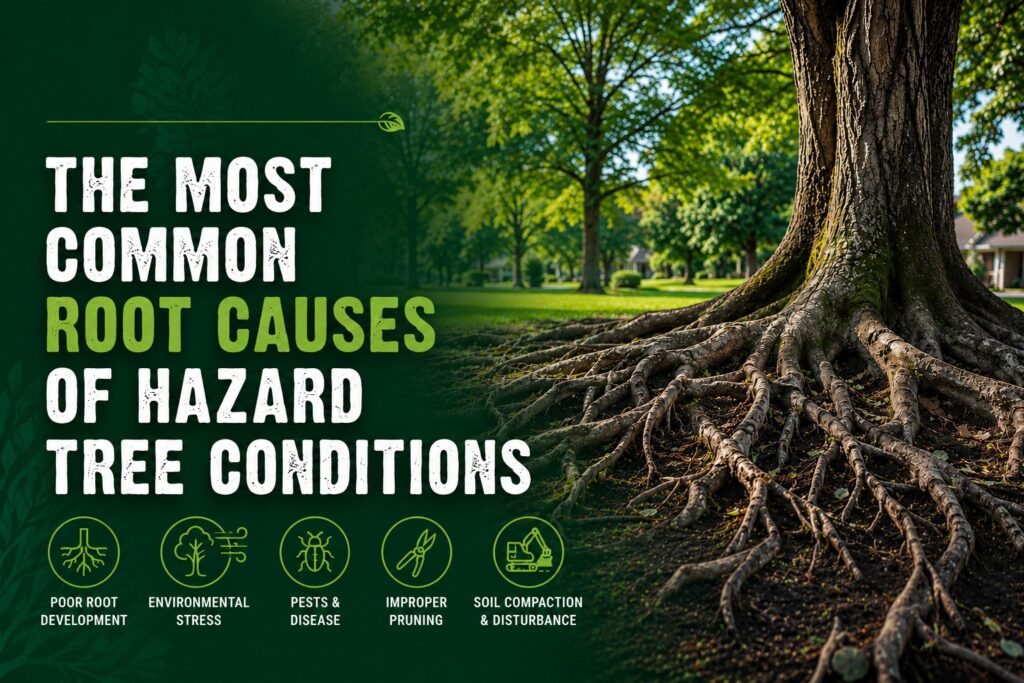
When people think about dangerous trees, they usually focus on what they can see above ground, a leaning trunk, dead branches, a hollow cavity, or a cracked limb. But in many cases, the real problem is hidden underground.
According to the International Society of Arboriculture (ISA), root defects, soil conditions, and root damage are among the most important factors evaluated during professional tree risk assessments because roots provide both structural support and access to water and nutrients. When roots fail, the entire tree becomes vulnerable to decline or collapse.
In fact, many tree failures that occur during storms are not caused solely by wind. The wind simply exposes problems that have often been developing underground for years. Arborists frequently find that a fallen tree’s root system had already been weakened by construction damage, decay, soil compaction, girdling roots, or poor growing conditions long before the tree came down.
For Michigan homeowners, understanding these root-related hazards is critical. Severe thunderstorms, saturated spring soils, snow loads, and aging urban trees can all amplify underground problems that often go unnoticed until failure occurs.
Let’s look at the most common root causes of hazardous tree conditions and why professional assessment matters.
Why Tree Roots Matter More Than Most People Realize
Tree roots do much more than absorb water.
Research from Forest Research explains that root systems perform several critical functions:
- Anchor the tree against wind forces
- Gather water and nutrients
- Store energy reserves
- Support overall tree health
- Stabilize the surrounding soil
A tree’s structural integrity depends heavily on the condition of its root system. Even a tree with a healthy-looking canopy may be at risk if its roots have been compromised.
The challenge is that roots are largely hidden from view. Problems can develop underground for years before visible symptoms appear.
1. Root Decay and Root Disease
One of the most serious causes of hazardous tree conditions is root decay.
Unlike branch damage, root decay often remains invisible until the tree begins showing advanced symptoms or fails entirely.
The USDA Forest Service identifies root disease and decay fungi as major contributors to tree instability. These biological problems weaken structural roots that help hold trees upright.
Common warning signs include:
- Mushrooms or fungal conks near the trunk
- Sparse foliage
- Reduced annual growth
- Premature leaf drop
- Dieback in the upper canopy
- Leaning or shifting soil around the base
As decay progresses, roots lose their strength and ability to resist wind loads.
This is why apparently healthy trees sometimes uproot during storms.
The canopy may look fine while the root system has already been compromised.
2. Soil Compaction
Soil compaction is one of the most common yet overlooked causes of root stress in urban and suburban landscapes.
According to USDA climate and urban forestry guidance, many tree problems are directly related to poor soil conditions. Compacted soils reduce rooting volume, limit oxygen availability, restrict water movement, and interfere with root growth.
Common causes of compaction include:
- Construction activity
- Heavy equipment
- Repeated vehicle traffic
- Constant foot traffic
- Urban development
When soil becomes compacted:
- Roots struggle to expand
- Water infiltration decreases
- Oxygen levels decline
- Tree vigor decreases
Over time, this stress weakens the tree and increases vulnerability to disease and storm damage.
Many arborists consider soil compaction one of the most significant long-term threats to urban tree health.
3. Construction Damage
Construction-related root damage is responsible for countless tree failures.
Unfortunately, roots are often damaged long before anyone notices symptoms.
Forest Research notes that utility installation, trenching, road work, grading, and excavation frequently injure roots or reduce rooting space.
Common construction-related problems include:
- Root severing
- Soil grade changes
- Trenching near trees
- Heavy equipment compaction
- Root zone excavation
The danger is that trees may appear healthy for several years after damage occurs.
Meanwhile, root loss gradually reduces stability.
Eventually, a major storm arrives and exposes the underlying weakness.
This delayed response is one reason property owners often fail to connect tree failure to construction projects completed years earlier.
4. Stem-Girdling Roots
Girdling roots are one of the most misunderstood root defects.
These roots grow around the base of the trunk rather than extending outward into the soil.
Over time, they compress the tree’s vascular system and restrict the movement of water and nutrients.
Research on stem-girdling roots shows they can contribute to:
- Canopy decline
- Reduced vigor
- Poor trunk development
- Structural instability
- Increased failure risk
Severe girdling roots may eventually contribute to tree collapse because they compromise both root function and trunk support.
Warning signs include:
- Lack of visible root flare
- Trunk narrowing near the base
- Sparse foliage
- Branch dieback
- Surface roots circling the trunk
Many girdling root problems originate during planting or nursery production and worsen over decades.
5. Limited Rooting Space
Trees need room to grow underground.
Urban environments often provide far less space than trees require.
Research on urban tree root systems identifies restricted soil volume as a major contributor to root stress and long-term decline.
Common limitations include:
- Sidewalks
- Roads
- Parking lots
- Foundations
- Utility corridors
When roots cannot expand naturally, trees become more vulnerable to:
- Drought stress
- Nutrient deficiencies
- Structural instability
- Root conflicts with infrastructure
Many urban trees spend their entire lives adapting to restricted rooting conditions.
Eventually, these limitations may contribute to hazardous conditions.
6. Soil Saturation and Poor Drainage
Too much water can be just as harmful as too little.
The ISA specifically identifies frequently saturated soils as an important risk factor because excessive moisture can contribute to root decay and reduced soil strength.
Michigan homeowners often encounter:
- Spring flooding
- Poorly drained clay soils
- Extended wet periods
- Water accumulation around root zones
When roots remain waterlogged:
- Oxygen becomes limited
- Root growth slows
- Disease pressure increases
- Structural support decreases
Saturated soils can also make uprooting more likely during wind events because the soil itself provides less resistance.
7. Root Severing and Utility Work
Root cutting is one of the most common causes of instability in mature trees.
The ISA’s tree risk assessment framework specifically identifies cut roots as a major concern when evaluating hazard potential.
Utility installations often involve:
- Sewer repairs
- Water line work
- Cable installation
- Gas line projects
- Drainage improvements
Unfortunately, large structural roots may be severed during these projects.
The USDA Forest Service notes that significant root damage often remains hidden until visible decline or failure develops.
8. Soil Erosion Around Root Systems
Root systems rely on the surrounding soil for support.
When erosion removes soil around roots, trees lose both anchorage and access to nutrients.
Hazard tree assessment guidance identifies erosion as a significant root concern because exposed roots often indicate reduced stability.
Causes of erosion include:
- Heavy rainfall
- Poor drainage
- Slope instability
- Improper grading
Over time, erosion may expose structural roots and increase the likelihood of uprooting.
9. Improper Planting Practices
Many hazardous tree conditions begin the day a tree is planted.
Poor planting practices can create long-term root problems, such as:
- Girdling roots
- Restricted root growth
- Poor root establishment
- Chronic stress
Improper planting depth is particularly common.
When the root flare is buried too deeply, roots often develop abnormally and become more vulnerable to decay and girdling.
Years later, these defects may contribute to structural failure.
Why Root Problems Often Go Undetected
The most dangerous aspect of root-related hazards is that they frequently remain invisible.
Unlike dead branches or trunk cracks, root defects are hidden underground.
The ISA’s risk assessment process specifically includes evaluation of:
- Root collar conditions
- Soil characteristics
- Root damage
- Root decay indicators
- Root plate movement
- Soil compaction
These factors help arborists identify problems before failure occurs.
How Professional Hazard Assessments Help
Because root problems are difficult to diagnose without training, professional assessment is essential.
Certified arborists evaluate:
- Root stability
- Soil conditions
- Decay indicators
- Lean patterns
- Construction impacts
- Site history
- Failure potential
Importantly, not every root defect requires removal.
Many trees can be managed through:
- Root collar excavation
- Soil improvement
- Structural pruning
- Monitoring programs
- Risk mitigation strategies
The goal is to identify hazards early and make informed decisions before failure occurs.
Why Tree Solutions Emphasizes Root Health
At Tree Solutions LLC, hazard tree evaluations extend beyond what is visible in the canopy. Understanding root conditions is essential because many tree failures originate underground long before symptoms appear above ground.
By assessing root health, soil conditions, construction impacts, and structural stability, professional evaluations help determine whether a tree should be monitored, treated, pruned, or removed.
A proactive approach often prevents costly property damage while preserving healthy trees whenever possible.
Final Thoughts
When a tree fails during a storm, the wind is often blamed. But in many cases, the true cause has been developing underground for years.
Root decay, soil compaction, construction damage, girdling roots, saturated soils, erosion, and restricted rooting space are among the most common root-related factors that contribute to hazardous tree conditions. Research consistently shows that healthy roots are fundamental to tree stability and long-term survival.
For Michigan homeowners, where severe weather and urban growing conditions place additional stress on trees, regular inspections can identify hidden root problems before they become dangerous.
Because when it comes to tree safety, what lies beneath the soil often matters far more than what you can see above it.