
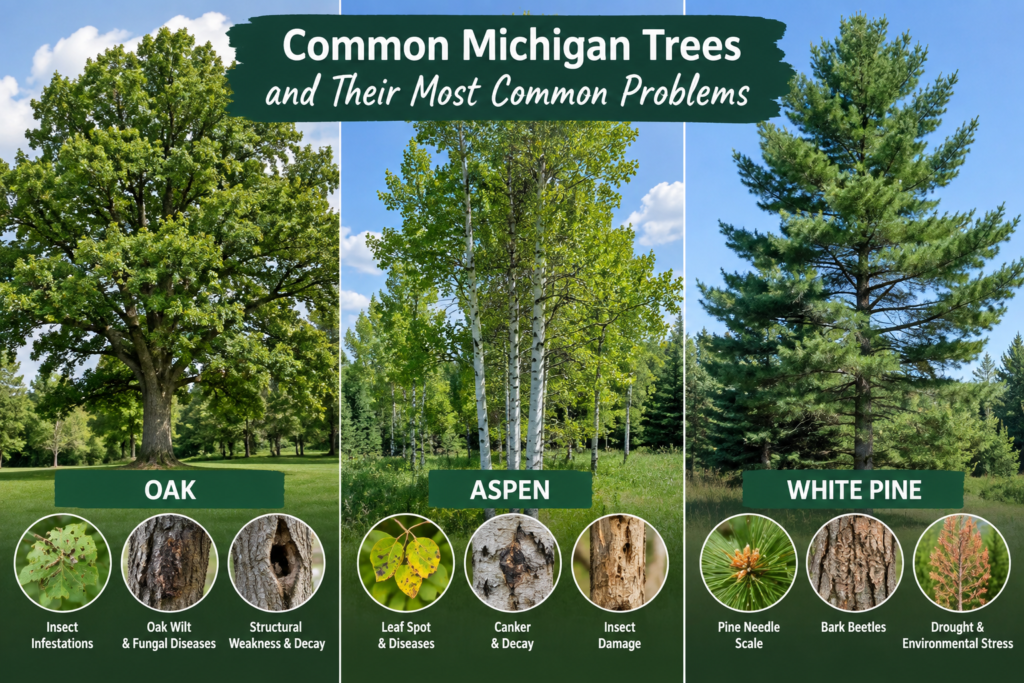
Michigan is home to a wide range of trees, from sugar maples and red oaks to white pines, birches, aspens, and eastern hemlocks. Many of these trees grow well in Michigan’s climate. Being native or well established does not make a tree safe from disease, insects, weather damage, or structural problems.
Michigan’s forests cover about 20 million acres. Annual forest-health reports still list major threats to tree health. These include pests, diseases, environmental stress, and severe weather.
For homeowners, the challenge is recognizing when a normal-looking change is harmless and when it signals a problem that needs professional attention.
Here are some of the common Michigan trees you may encounter and the problems that deserve attention.
Sugar Maple: Decline and Environmental Stress
Sugar maple is one of Michigan’s best-known trees and an important component of the state’s northern hardwood forests. It is also a popular landscape tree because of its attractive shape and brilliant fall color.
However, sugar maples can experience decline when environmental conditions put them under prolonged stress. USDA Forest Service research on Michigan forests has associated maple decline with poor soil conditions and weather-related stress. Crown dieback has also been associated with disturbances around the root zone.
For homeowners, decline may appear as thinning foliage, dead branches, reduced growth, or sections of the canopy dying back.
A stressed maple doesn’t necessarily need to be removed. The first step is determining what is causing the decline. Compacted soil, root damage, drought, pests, disease, or multiple stress factors can all contribute.
Red Maple: Stress and Structural Problems
Red maple is highly adaptable and is commonly planted in Michigan landscapes. Michigan DNR lists it as a suitable tree for several landscape settings, including parks, lawns, streets, and riparian areas.
Despite its adaptability, red maple can still develop structural problems, particularly when branches grow with weak attachments or the tree has been damaged by storms.
Homeowners should pay attention to dead branches, cracks, major limbs with poor attachments, and sudden leaning. These issues become more important when a mature tree stands close to a home, driveway, or other frequently used area.
Proper pruning when a tree is young can help develop stronger structure. Once a mature tree has large or hazardous limbs, professional tree trimming is much safer than attempting to remove them yourself.
Oak: Oak Wilt Is a Serious Concern
Oaks are among Michigan’s most recognizable hardwoods, but they have a particularly important disease concern: oak wilt.
Michigan DNR states that oak wilt can quickly kill healthy red oaks, while white oaks can also become infected but are generally more resistant. One of the most important prevention measures is avoiding pruning oak trees during the period when the disease can spread through beetles entering fresh wounds. Michigan DNR currently recommends avoiding oak pruning from April 15 through July 15.
Symptoms can include sudden leaf loss during summer and rapid decline.
If an oak suddenly begins losing leaves outside its normal seasonal cycle, don’t assume it is simply suffering from drought. Oak wilt and other problems can produce serious symptoms, and an accurate diagnosis matters before any major work is performed.
Ash: Emerald Ash Borer
Ash trees have faced one of Michigan’s most significant invasive insect threats: the emerald ash borer (EAB).
Michigan DNR confirms that emerald ash borer is present in Michigan. Its larvae feed beneath the bark and disrupt the tissues responsible for transporting water and nutrients through the tree.
Signs of an affected ash can include thinning foliage, branch dieback, vertical splits in the bark, epicormic shoots, and D-shaped exit holes.
USDA Forest Service research has identified the emerald ash borer as a nonnative pest. It has had a major impact on Michigan’s forest health.
An ash tree with extensive decline can become a safety concern because weakened branches can break unexpectedly. If you have mature ash trees near your home or other structures, a professional can evaluate them. They can help decide if the tree can be managed or if it must be removed.
Aspen: Rapid Growth and Decline
Aspens are common across Michigan and play an important role in the state’s forests. However, their health can be affected by several secondary pests and diseases, particularly when the trees are already stressed.
USDA Forest Service research has linked declining aspen to problems including Armillaria root rot, bronze poplar borer, leaf-mining insects, Septoria leaf spot, and Hypoxylon canker.
This is a good example of why simply treating the visible symptom may not solve the underlying problem.
If an aspen is losing branches or developing extensive dead areas, the condition of the trunk and root system should also be considered.
Birch: Bronze Birch Borer and Stress
Paper birch and river birch are both found in Michigan landscapes. Michigan DNR identifies bronze birch borer as a health concern for both species.
Birches can also become stressed by unfavorable growing conditions. A stressed tree may be more vulnerable to insects and other problems than a healthy one.
Watch for thinning foliage, branch dieback, changes in bark, and declining overall vigor. If a mature birch is deteriorating near a structure, don’t wait until large branches begin falling before having it evaluated.
White Pine: Storm and Pest Damage
Eastern white pine is Michigan’s state tree and can grow into a very large tree. Its size makes location and maintenance particularly important around homes.
White pine can also be affected by pests, diseases, and environmental stress. USDA Forest Service research has documented white pine decline in Michigan and identified several factors associated with the health of affected trees.
Storm damage is another concern. Large branches can break under heavy snow, ice, or strong winds, and mature trees can become difficult to manage without specialized equipment.
Michigan’s recent severe weather has demonstrated how quickly storm damage can affect large numbers of trees. The 2025 northern Michigan ice storm, for example, damaged thousands of trees across 13 counties.
Red Pine: Root Disease and Storm Damage
Red pine is another important Michigan conifer. Michigan DNR’s tree-planting guidance identifies Heterobasidion root disease as a health concern for red pine.
Root diseases can be difficult for homeowners to recognize because the problem begins below ground. Declining crown health, abnormal growth, or unexplained tree death may be signs that something is wrong with the root system.
Red pine can also become vulnerable after storm damage. Michigan DNR has advised property owners to focus on cleaning up damaged pine. Downed or stressed pine can attract pine bark beetles.
American Beech: Beech Bark and Beech Leaf Disease
Michigan’s American beech trees face two significant health concerns: beech bark disease and beech leaf disease.
Michigan DNR reports that beech bark disease involves a combination of sap-feeding scale insects and a fungus. Beech leaf disease is linked to a tiny nematode. It can cause leaf curling, puckering, banding, and leaf loss. Repeated damage can weaken trees and contribute to mortality.
A mature beech with major canopy decline needs attention, especially near a home, walkway, or other area. Falling branches could become a hazard.
Eastern Hemlock: Hemlock Woolly Adelgid
Eastern hemlock is another native Michigan tree that can be affected by an invasive pest known as hemlock woolly adelgid.
The insects feed on the tree’s sap and can damage needles, shoots, and branches. Michigan DNR lists hemlock woolly adelgid as a species of concern in Michigan.
If a hemlock begins showing thinning foliage or branch dieback, early evaluation can be important. A professional can help determine whether the symptoms are related to pests, environmental stress, disease, or another issue.
Not Every Tree Problem Means Tree Removal
Seeing disease, deadwood, or insect activity doesn’t automatically mean a tree needs to come down.
Michigan DNR’s recommended tree guidance emphasizes that tree selection, site conditions, mature size, and potential health concerns all affect long-term tree performance.
Depending on the problem, appropriate pruning, treatment, monitoring, or changes to the tree’s growing conditions may be enough.
Removal becomes a consideration when a tree is severely compromised, structurally unstable, dead, or presenting an unacceptable risk to people or property.
That distinction matters. Good tree care isn’t about removing trees whenever something looks wrong. It’s about understanding the condition of the tree and choosing the safest appropriate response.
When to Call a Professional Tree Service
Some warning signs shouldn’t be ignored, especially when the tree is large or located near a structure.
Large dead branches, significant cracks, sudden leaning, extensive decay, exposed roots, major storm damage, hanging limbs, and rapid canopy decline can all justify professional evaluation.
Michigan DNR’s current forest-health guidance says pests, diseases, and weather can work together to weaken trees.
It also notes that a problem may not have one clear cause.
Trying to diagnose or remove a large hazardous tree yourself can also create additional risks. Professional equipment and experience are particularly important when a tree is close to a roof, utility line, fence, vehicle, or other structure.
Protect Your Michigan Trees Before a Small Problem Becomes a Hazard
Michigan trees face everything from invasive insects and fungal diseases to drought, poor soil conditions, ice, snow, and high winds. Some problems develop slowly, while others can cause a tree to decline surprisingly quickly.
The earlier a problem is recognized, the more options you may have.
Tree Solutions LLC can assess trees with signs of decline, storm damage, or weak structure. They can determine if trimming, maintenance, or removal is needed.
If you have a tree that doesn’t look right, don’t wait for a major limb to fall or the entire tree to become unstable. Professional tree care can help address problems before they become a much larger safety or property issue.
Final Thoughts
Common Michigan trees such as maple, oak, ash, aspen, birch, pine, beech, and hemlock can live for decades when the right conditions are maintained. But even healthy species can face serious problems from pests, disease, environmental stress, and severe weather.
Knowing the warning signs is the first step. Getting the tree properly assessed is the next.
Whether a tree needs careful care or should be removed for safety, act early to protect your property. This also helps protect nearby trees.
If you are worried about a tree on your Michigan property, contact Tree Solutions LLC. We provide professional tree care to guide your next step.